

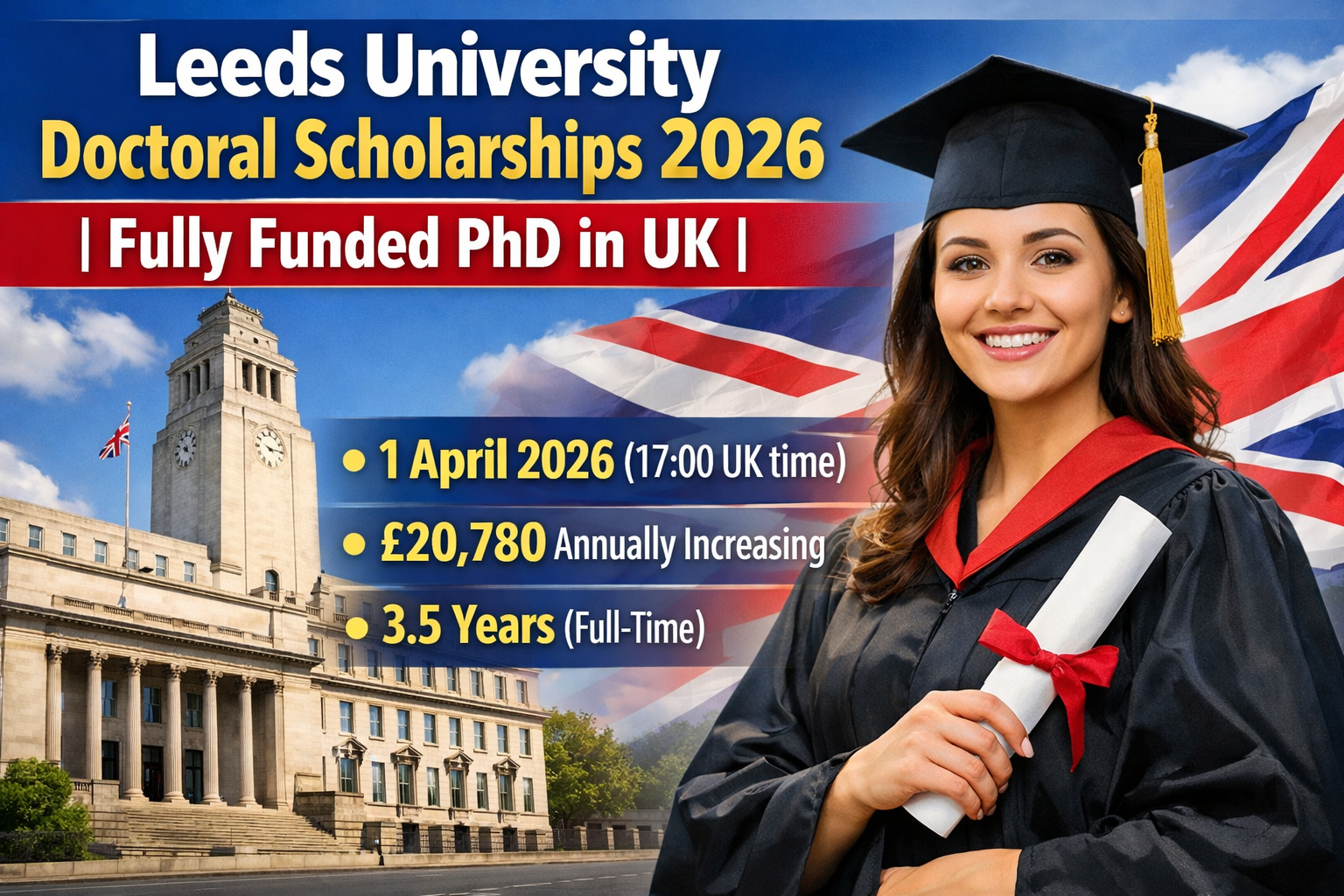
| Host University | University of Leeds, Leeds, UK |
| Degree Level | PhD (Doctoral Research) |
| Funding Type | Fully Funded |
| Deadline | 1 April 2026 (17:00 UK time) |
| Start Date | By 1 October 2026 |
| Duration | 3.5 years (full-time) | Pro-rata part-time |
| Annual Stipend | £20,780 (increases annually with UKRI rates) |
| Eligibility | Home (UK) fee-rated students |
| Apply Link | Find Below |
Introduction: What Are the Leeds University Doctoral Scholarships 2026?
Are you a highly motivated student with a passion for research and a dream of pursuing a PhD in the United Kingdom? If so, the Leeds University Doctoral Scholarships 2026 could be the life-changing opportunity you have been waiting for. Offered by the prestigious University of Leeds, these fully funded PhD scholarships are designed to attract the brightest academic minds and support them through a world-class doctoral research journey.
The Leeds Doctoral Scholarships 2026 are among the most competitive and rewarding PhD funding opportunities available in the UK today. Each year, up to five scholarships are awarded to outstanding candidates across all faculties, making this a rare and highly sought-after honour. The scholarship covers full tuition fees and provides a generous annual maintenance grant, giving recipients the financial stability to focus entirely on their research.
Whether you are interested in artificial intelligence, environmental science, social policy, business, medicine, or the humanities, the University of Leeds offers a diverse research environment that welcomes scholars from a wide range of disciplines. This article provides a comprehensive, SEO-optimised guide to everything you need to know about the Leeds University Doctoral Scholarships 2026 from eligibility and benefits to the step-by-step application process.
About the University of Leeds
Founded in 1904, the University of Leeds is one of the United Kingdom’s largest and most respected research-intensive universities. Located in Leeds, West Yorkshire, the university is home to more than 38,000 students from over 170 countries and employs a world-class faculty of researchers, academics, and innovators.
The University of Leeds is consistently ranked among the top universities in the UK and globally, appearing in the QS World University Rankings, the Times Higher Education World University Rankings, and the Academic Ranking of World Universities. It is particularly recognised for its strengths in engineering, biomedical research, law, social sciences, business, and the arts and humanities.
Students at Leeds benefit from state-of-the-art research facilities, modern laboratories, and a vibrant campus community. The university fosters a culture of interdisciplinary collaboration and global engagement, providing doctoral researchers with access to international networks, expert supervision, and cutting-edge resources. For PhD candidates, few environments offer as rich and supportive a research ecosystem as the University of Leeds.
Leeds Doctoral Scholarships 2026: Overview and Key Facts
The Leeds University Doctoral Scholarships 2026 are university-funded awards administered through an internal academic selection process. Unlike externally funded government scholarships, these awards are managed by individual schools and finalised by a central University Scholarship Selection Panel, ensuring that only the most academically excellent candidates are chosen.
Up to five scholarships are available for the 2026/27 academic session, open to students wishing to conduct PhD research across any faculty at the University of Leeds. The award is initial for one year and renewed annually, subject to satisfactory academic progress, for a total funding period of 3.5 years for full-time researchers.
This scholarship is strictly merit-based. Financial need plays no part in the selection process. What matters most is your academic track record, the quality of your research proposal, and your potential to contribute meaningfully to your chosen field of study.
Eligible Fields of Study and Research Areas
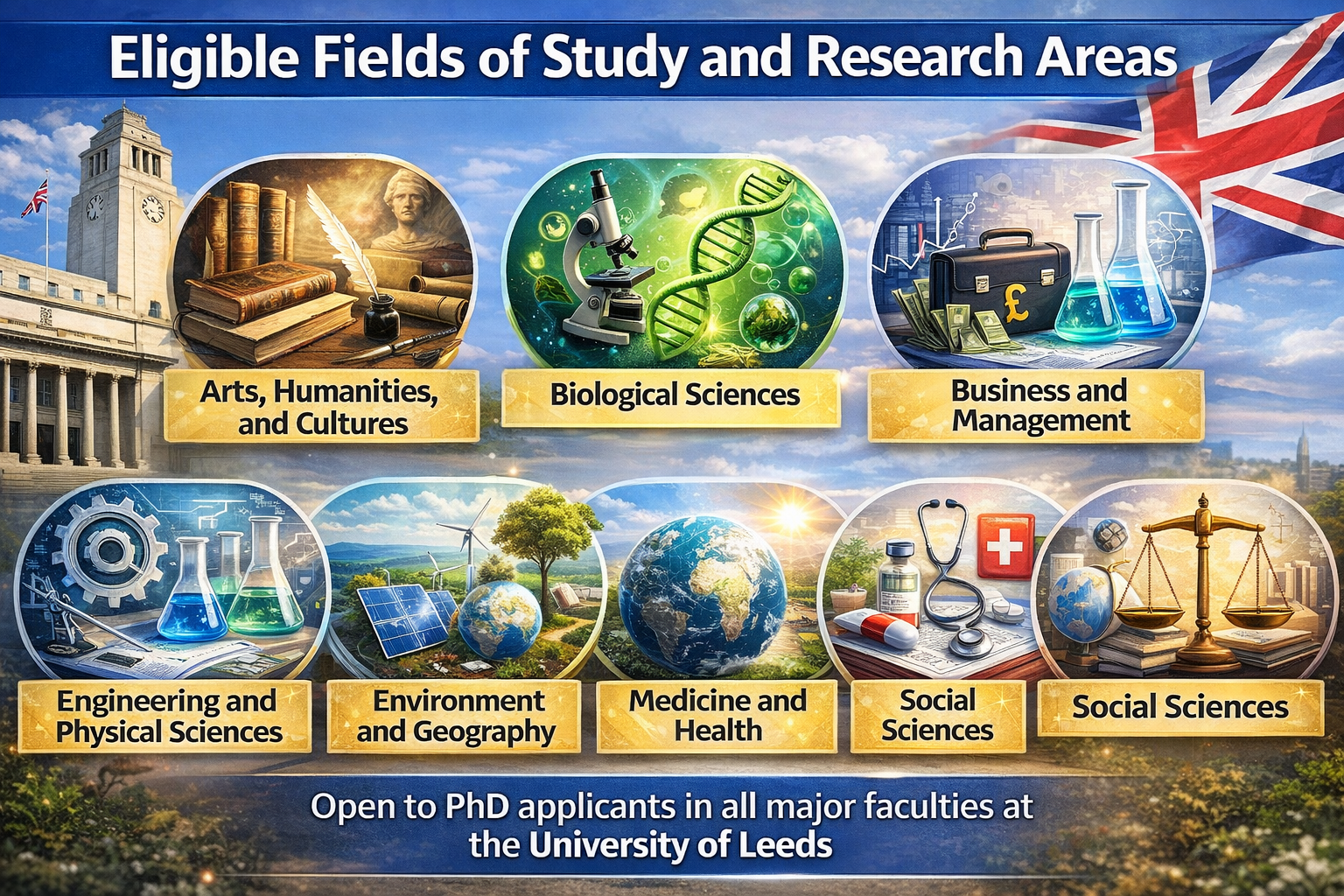
One of the most attractive aspects of the Leeds University Doctoral Scholarships 2026 is their broad scope. The scholarship is open to PhD applicants across all major faculties at the University of Leeds. Eligible faculties and research areas include:
- Arts, Humanities, and Cultures – including history, languages, literature, philosophy, film, music, and cultural studies
- Biological Sciences – covering genetics, ecology, molecular biology, microbiology, and bioinformatics
- Business and Management – including marketing, finance, strategy, operations, entrepreneurship, and organisational behaviour
- Engineering and Physical Sciences – spanning civil, mechanical, chemical, and electrical engineering, physics, chemistry, and materials science
- Environment and Geography – including climate science, sustainability, urban planning, and environmental management
- Medicine and Health – covering clinical research, public health, epidemiology, nursing, and allied health sciences
- Social Sciences – including sociology, politics, economics, law, education, and international development
This wide-ranging eligibility means that regardless of your academic background, there is very likely a research pathway at the University of Leeds that aligns with your interests and career goals.
Scholarship Benefits: What Does the Leeds Doctoral Scholarship Cover?
The Leeds University Doctoral Scholarships 2026 offer a comprehensive funding package designed to eliminate financial barriers and allow recipients to dedicate themselves fully to their doctoral research. Here is a detailed breakdown of what the scholarship provides:
1. Full Tuition Fee Coverage
The scholarship covers full academic tuition fees for the standard doctoral registration period. For full-time PhD researchers, this means tuition fees are paid for three years, removing a significant financial burden from the recipient’s shoulders. Part-time researchers receive tuition fee coverage on a pro-rata basis.
2. Annual Maintenance Grant
In addition to tuition fees, scholarship holders receive a generous annual maintenance grant to help cover living expenses. For the 2025/26 session, the stipend is set at £20,780 per year for full-time researchers. This amount is reviewed and increased annually in line with the UKRI (UK Research and Innovation) rate, ensuring that the grant keeps pace with the cost of living.
3. Duration of Funding
The maintenance grant is paid for the full 3.5 years of full-time PhD study. Tuition fees are covered for the first three years. For part-time researchers, all components of the award are provided on a pro-rata basis proportional to the study load.
4. Access to World-Class Research Infrastructure
Beyond direct financial support, Leeds Doctoral Scholarship holders benefit from access to the University of Leeds’ extensive research infrastructure, including modern laboratory facilities, cutting-edge digital tools, specialist libraries, and collaborative research centres. This access empowers scholars to conduct high-impact research across all disciplines.
5. Expert Supervision and Academic Support
Each doctoral researcher at the University of Leeds is assigned dedicated supervisors who are leaders in their respective fields. Supervisors provide ongoing academic guidance, mentoring, and career development support throughout the PhD journey, ensuring that scholarship holders are well-equipped to succeed and publish impactful research.
6. International Research Opportunities
The University of Leeds maintains strong international partnerships with leading universities, research institutions, and industry organisations around the world. Doctoral scholars benefit from opportunities to collaborate internationally, attend global conferences, and engage with research networks that extend far beyond the Leeds campus.
⚠️ Important Note: The scholarship does not cover relocation expenses, visa costs, NHS health surcharge, or dependent support. These costs remain the responsibility of the scholarship holder.
Eligibility Criteria for Leeds University Doctoral Scholarships 2026
Before investing time in preparing your application, it is essential to confirm that you meet all of the following eligibility requirements. The University of Leeds is very clear that only candidates who satisfy every criterion will be considered for the award.
Academic Qualification Requirements
- Applicants must hold a first degree at undergraduate level equivalent to at least a UK First Class Honours degree. This is the standard minimum academic requirement.
- Applicants with a lower undergraduate classification may still be considered if they hold — or expect to hold — a Master’s degree at Distinction level, or if they can demonstrate significant relevant professional or research experience (for example, substantial industry experience).
- A Master’s degree is not strictly mandatory but can significantly strengthen the application, particularly for candidates whose undergraduate results fall below first-class level.
Fee Status Requirement
- Applicants must be classified as Home (UK) fee-paying students for tuition purposes under current UK government regulations. This is a firm requirement and is separate from nationality – Home fee status is determined by residency criteria, not citizenship alone.
- It is important to note that some scholarships at the University of Leeds do accommodate refugees, asylum seekers, and those granted humanitarian protection status by the UK Government under the Home fee-rated category.
PhD Registration Status
- The scholarship is exclusively available to new postgraduate researchers. Students who are already registered or enrolled on a PhD programme at any institution are not eligible to apply.
- Applicants who previously commenced but did not complete a PhD programme may be considered on a case-by-case basis.
- Applicants who have already been awarded a PhD degree are ineligible to apply.
English Language Proficiency
- Applicants whose first language is not English must demonstrate proficiency in English. The University of Leeds’ minimum requirement is typically an IELTS Academic score of 6.0 overall, with no individual component falling below 5.5.
- Some faculties and schools may require higher English language scores. Applicants should verify the specific requirements of their chosen school when preparing their application.
Residency During the Scholarship Period
- Scholarship holders must live within a reasonable commuting distance of the University of Leeds campus throughout the period in which they receive the award. This is a condition of holding the scholarship and must be maintained for its duration.
Start Date Requirement
- All awards must be taken up by 1 October 2026. Candidates who are unable to commence their studies by this date will not be eligible to hold the scholarship.
Required Documents for Leeds University Doctoral Scholarships 2026
Preparing a strong, complete application is critical. The University of Leeds will not consider applications that are missing any required supporting documents by the scholarship deadline. The following documents are typically required:
- Certified academic transcripts from all universities and higher education institutions attended
- Official degree certificates or provisional certificates if the final award has not yet been conferred
- A well-structured and detailed research proposal outlining your proposed topic, methodology, and expected contribution to the field
- An up-to-date curriculum vitae (CV) highlighting your academic achievements, research experience, publications, and any relevant professional experience
- Evidence of English language proficiency (IELTS, TOEFL, or equivalent — check faculty-specific requirements)
- Two strong letters of recommendation from academic referees who can speak to your research ability and academic potential
- A personal statement explaining your motivation for pursuing a PhD at Leeds, your research interests, and your long-term career goals
- Any additional documents specified by your chosen faculty or school (check individual school requirements carefully)
Tip: Contacting your prospective supervisor before submitting your application is highly recommended. A letter of support or indication of interest from a supervisor can significantly strengthen your candidacy.
Step-by-Step Application Process for Leeds University Doctoral Scholarships 2026
The application for the Leeds University Doctoral Scholarships 2026 is a two-stage process. Both stages must be completed correctly and on time for your application to be considered.
Stage 1: Apply for a PhD Research Programme
Begin by submitting a formal application for a PhD research programme at the University of Leeds through the university’s official online application portal. You should clearly specify the faculty, school, and research area you wish to pursue, and identify a potential supervisor whose research aligns with your interests.
Your application must include all required supporting documents as specified by the relevant school or faculty. Incomplete applications will not be advanced to the scholarship consideration stage, so ensure everything is in order before submitting.
Once your application is processed, you will receive a 9-digit Student Application ID. You will need this number to proceed to Stage 2.
Stage 2: Complete the Scholarship Application Form
Using your 9-digit Student Application ID, complete the online Leeds Doctoral Scholarship application form. This form is separate from your PhD programme application and must be submitted before the scholarship deadline.
In your scholarship application, you will be asked to provide information about your academic background, research proposal, and motivation for applying. Make sure to clearly articulate why your research is significant, how it aligns with the University of Leeds’ research priorities, and why you are an exceptional candidate for this prestigious award.
Key Deadlines
- Scholarship application deadline: Wednesday, 1 April 2026 at 17:00 UK time
- Awards must be taken up by: 1 October 2026
- Results are typically announced within 10 weeks of the closing date
Selection Process
After the deadline, each school reviews and shortlists candidates from its pool of applicants and nominates them to the central University of Leeds Scholarship Selection Panel. The Selection Panel then makes final decisions based solely on academic merit financial need is not taken into account at any stage.
If your scholarship application is unsuccessful, this does not affect your eligibility for other funding opportunities at the University of Leeds. You may still be considered for other scholarships, bursaries, or research council funding.
Tips to Strengthen Your Application for Leeds University Doctoral Scholarships 2026
Given the highly competitive nature of the Leeds University Doctoral Scholarships 2026, it is worth going beyond the minimum requirements to make your application stand out. Here are some evidence-based strategies to improve your chances:
- Contact your prospective supervisor early: Reaching out to a potential PhD supervisor before applying demonstrates initiative and allows you to refine your research proposal based on their feedback. A positive response or expression of support from a supervisor can be very influential.
- Write a compelling research proposal: Your research proposal should be clear, well-structured, and demonstrate that you have a thorough understanding of the existing literature, a well-defined research question, and a feasible methodology. Avoid vague or overly broad topics.
- Tailor your personal statement: Generic personal statements rarely succeed in competitive scholarship applications. Explain specifically why Leeds, why this supervisor, and why this research topic — and connect your academic background to your future research goals.
- Secure strong references: Choose referees who know your academic work well and can speak specifically to your research potential. Brief them on your research proposal and the scholarship so they can write targeted, relevant letters.
- Apply early: Although the deadline is 1 April 2026, submitting your application well ahead of time gives you the opportunity to address any issues or missing documents without last-minute pressure.
- Highlight research output: Any prior publications, conference presentations, research projects, or awards should be prominently featured in your CV and personal statement.
Frequently Asked Questions (FAQs)
Is the Leeds University Doctoral Scholarships 2026 open to international students?
The standard Leeds Doctoral Scholarship (reference 209) is open only to candidates who are classified as Home (UK) fee-rated students under current UK regulations. However, international students may be eligible for other funding opportunities at the University of Leeds, such as faculty-specific scholarships or research council partnerships. It is worth exploring the full range of doctoral funding options available on the Leeds PhD funding portal.
Do I need a Master’s degree to apply?
A Master’s degree is not strictly required. However, applicants with an undergraduate degree below first-class level must hold or expect to hold a Master’s degree at Distinction level, or demonstrate significant relevant professional experience. For applicants with a first-class undergraduate degree, a Master’s qualification strengthens the application further but is not mandatory.
How many scholarships are awarded each year?
Up to five Leeds Doctoral Scholarships are available for the 2026/27 session. This makes the scholarship highly competitive, which is why strong academic credentials, an outstanding research proposal, and early engagement with potential supervisors are so important.
Can I apply if I am already registered for a PhD?
No. The scholarship is exclusively for new postgraduate researchers who are not currently enrolled in a PhD programme. If you have previously commenced a PhD but did not complete it, you may still be eligible — each case is considered individually.
When will I hear the outcome of my application?
The University of Leeds aims to announce results within 10 weeks of the scholarship closing date of 1 April 2026. Successful applicants are notified and their names published internally within the university.
Does an unsuccessful scholarship application affect my PhD admission?
No. An unsuccessful scholarship application has no bearing on your PhD programme application. You may still be admitted to the programme and considered for alternative funding opportunities at Leeds.
Why Choose the Leeds University Doctoral Scholarships 2026 for Your PhD?
The University of Leeds is not simply a venue for academic study it is a dynamic research community with a proven record of world-leading discovery, social impact, and innovation. Here are some of the most compelling reasons to choose Leeds for your doctoral journey:
- Global research reputation: The University of Leeds is consistently ranked among the top research universities in the UK and the world, with particular excellence in engineering, life sciences, health research, social sciences, and the arts.
- Dedicated doctoral community: Leeds has a large, thriving postgraduate research community, offering dedicated doctoral training programmes, regular research seminars, writing retreats, and interdisciplinary networks.
- Exceptional supervisors: PhD researchers at Leeds are supervised by internationally recognised scholars who are active in their fields, publishing cutting-edge research and contributing to global policy and practice.
- Career development: The university provides a range of professional development workshops, skills training, and career advisory services specifically designed to help PhD researchers succeed both inside and outside academia.
- Quality of life: Leeds is one of the UK’s most vibrant cities, offering a high quality of life, excellent transport links, a thriving cultural scene, and a cost of living significantly lower than London – making the £20,780 annual stipend go considerably further.
Final Thoughts: Should You Apply in Leeds University Doctoral Scholarships 2026?
The Leeds University Doctoral Scholarships 2026 represent one of the UK’s most prestigious and generously funded doctoral opportunities. If you meet the eligibility criteria – particularly the Home fee-rated student requirement – and have a strong academic record and a compelling research vision, you should absolutely apply.
The combination of full tuition fee coverage, a substantial annual maintenance grant that increases each year, 3.5 years of funding, and access to one of the UK’s finest research universities makes this scholarship an extraordinary platform for launching a successful academic and research career.
With a deadline of 1 April 2026, the time to start preparing is now. Identify a supervisor, refine your research proposal, gather your documents, and submit a strong, targeted application. A well-prepared applicant who has engaged with their prospective supervisor and submitted a focused, high-quality research proposal stands the best chance of earning one of these coveted awards.
Apply Now: phd.leeds.ac.uk/funding/209-leeds-doctoral-scholarships-2026
Application Deadline: 1 April 2026 at 17:00 UK time
Disclaimer
This article is an informational guide compiled from publicly available sources including the official University of Leeds PhD funding portal. All details – including stipend amounts, eligibility conditions, and deadlines — are accurate at the time of writing but may be subject to change. Always refer to the official University of Leeds website for the most up-to-date information before applying.
Also check out other UK scholarships: See more